-
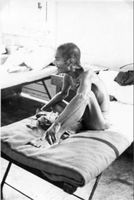 068 Long stay male tuberculosis patient
 It is necessary for some Orang Asli to be hospitalised for long term treatment. Some older men are on their own as their families decide to remain in their kampongs.
-
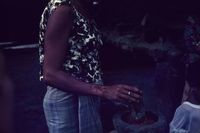 015 Pounding spices
 Orang Asli woman pounding spices to make curry paste. A popular curry dish was made with tiny fish called ikan bilis.
-
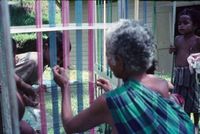 046 Weaving small mats
 When some old hospital screens were found discarded some Orang Asli women suggested we turn them into upright weaving looms. I found some weaving cotton and heddles and the women set up the looms. They then asked their menfolk to bring in rotan from the jungle which they cut up into strips for weaving. Small mats were made to take back to the kampongs, and also sets of tablemats were woven to sell to visitors to the hospital and various groups of ex-pats in Kuala lumpur etc.
-
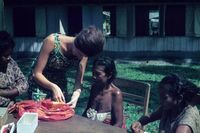 041 Sewing classes
 Orang Asli women usually just wear the sarong, tied at the waist or below the armpits. Contact with Malays had led many of them to wear the baju as well. When a large consignment of sewing kits from a US charity arrived at the hospital it was decided to classes in sewing. A couple of wives of Malay hospital staff helped me to make a paper pattern of a baju and so we were able to teach the women how to make a baju from start to finish. They started by choosing their material and progressed to cutting out the baju using the pattern. They then sewed the garment and fitted it. They learned very quickly and were very pleased to be given a sewing kit to take back to their kampongs. Later on, a couple of very ancient sewing machines were donated to the hospital and they proved to be popular too.
-
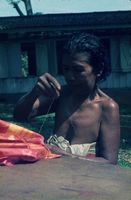 042 Sewing classes
 Orang Asli women usually just wear the sarong, tied at the waist or below the armpits. Contact with Malays had led many of them to wear the baju as well. When a large consignment of sewing kits from a US charity arrived at the hospital it was decided to classes in sewing. A couple of wives of Malay hospital staff helped me to make a paper pattern of a baju and so we were able to teach the women how to make a baju from start to finish. They started by choosing their material and progressed to cutting out the baju using the pattern. They then sewed the garment and fitted it. They learned very quickly and were very pleased to be given a sewing kit to take back to their kampongs. Later on, a couple of very ancient sewing machines were donated to the hospital and they proved to be popular too.
-
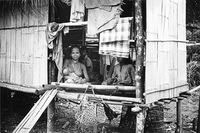 076 Semai mother nursing her child
 Looking into a family home interior. This photograph shows very clearly how the house has been constructed, as described above. Below you can see stored fish traps that are used in the Sungai Satah.
-
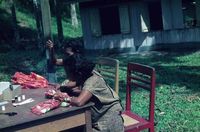 043 Sewing classes
 Orang Asli women usually just wear the sarong, tied at the waist or below the armpits. Contact with Malays had led many of them to wear the baju as well. When a large consignment of sewing kits from a US charity arrived at the hospital it was decided to classes in sewing. A couple of wives of Malay hospital staff helped me to make a paper pattern of a baju and so we were able to teach the women how to make a baju from start to finish. They started by choosing their material and progressed to cutting out the baju using the pattern. They then sewed the garment and fitted it. They learned very quickly and were very pleased to be given a sewing kit to take back to their kampongs. Later on, a couple of very ancient sewing machines were donated to the hospital and they proved to be popular too.
-
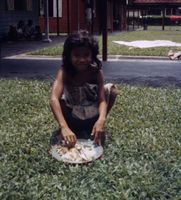 016 Eating Rice
 Rice forms the basis of much of Orang Asli cooking. In the jungle they grow their own crops. Ubi kayu, the tapioca root is also used in cooking.
-
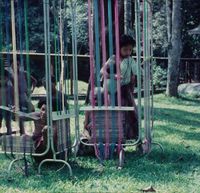 044 Weaving small mats
 Orang Asli women usually just wear the sarong, tied at the waist or below the armpits. Contact with Malays had led many of them to wear the baju as well. When a large consignment of sewing kits from a US charity arrived at the hospital it was decided to classes in sewing. A couple of wives of Malay hospital staff helped me to make a paper pattern of a baju and so we were able to teach the women how to make a baju from start to finish. They started by choosing their material and progressed to cutting out the baju using the pattern. They then sewed the garment and fitted it. They learned very quickly and were very pleased to be given a sewing kit to take back to their kampongs. Later on, a couple of very ancient sewing machines were donated to the hospital and they proved to be popular too.
-
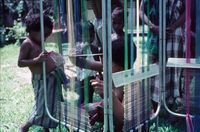 045 Weaving small mats
 When some old hospital screens were found discarded some Orang Asli women suggested we turn them into upright weaving looms. I found some weaving cotton and heddles and the women set up the looms. They then asked their menfolk to bring in rotan from the jungle which they cut up into strips for weaving. Small mats were made to take back to the kampongs, and also sets of tablemats were woven to sell to visitors to the hospital and various groups of ex-pats in Kuala lumpur etc.
-
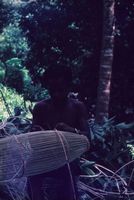 037 Making fish traps
 Fish traps are essential to the Orang Asli, and fortunately easy and quick to make. Bertam wood is collected from the nearby jungle and then cut into strips and woven into the traps. When ready, they are placed in the bottom of the river bed. At Gombak the Orang Asli were encouraged to make traps and use them in the Sungai Gombak to help supplement their diet. It also meant that they could carry on with their usual jungle activities despite being in the hospital environment. Some visitors to the hospital liked the fish traps so much that they bought them to use as lampshades!
-
 038 Making fish traps
 Fish traps are essential to the Orang Asli, and fortunately easy and quick to make. Bertam wood is collected from the nearby jungle and then cut into strips and woven into the traps. When ready, they are placed in the bottom of the river bed. At Gombak the Orang Asli were encouraged to make traps and use them in the Sungai Gombak to help supplement their diet. It also meant that they could carry on with their usual jungle activities despite being in the hospital environment. Some visitors to the hospital liked the fish traps so much that they bought them to use as lampshades!
-
 040 Making fish traps
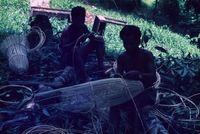
 Fish traps are essential to the Orang Asli, and fortunately easy and quick to make. Bertam wood is collected from the nearby jungle and then cut into strips and woven into the traps. When ready, they are placed in the bottom of the river bed. At Gombak the Orang Asli were encouraged to make traps and use them in the Sungai Gombak to help supplement their diet. It also meant that they could carry on with their usual jungle activities despite being in the hospital environment. Some visitors to the hospital liked the fish traps so much that they bought them to use as lampshades!
-
 017 Negrito Woman
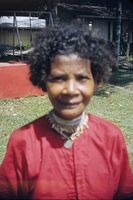
 During the 1960s it was quite rare to see any patients from the negrito tribes. They lived mainly in the north of the states of Kedah, Perak, Kelantan and Tregannu. While I was at Gombak there was only one family. They were from Perak and were from the Jahai tribe.
-
 035 Paraplegic patient
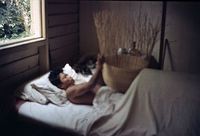
 Along was a longstay patient at Gombak. He was paralysed from the waist downwards and used a wheelchair. When the hospital telephone exchange was installed he and Apong, another paraplegic patient, were taught to operate it. They then became members of the hospital staff and received a wage. Until then, they earned a little pocket money by weaving baskets etc to order.
-
 075 Orang Asli Dwelling
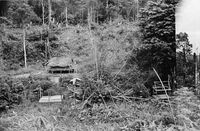
 Note the two wooden house frameworks in the foreground.
-
 039 Making fish traps
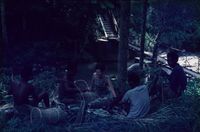
 Fish traps are essential to the Orang Asli, and fortunately easy and quick to make. Bertam wood is collected from the nearby jungle and then cut into strips and woven into the traps. When ready, they are placed in the bottom of the river bed. At Gombak the Orang Asli were encouraged to make traps and use them in the Sungai Gombak to help supplement their diet. It also meant that they could carry on with their usual jungle activities despite being in the hospital environment. Some visitors to the hospital liked the fish traps so much that they bought them to use as lampshades!
-
 030 Classrooms
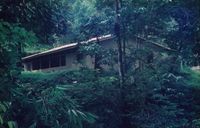
 This building was used to teach the children in the basic "3Rs" in Malay. They were always very eager to learn. The Field Staff also used the classrooms to learn English. This was usually taught by visiting European teachers from Kuala Lumpur on a voluntary basis. The building also had a four bed ward for paraplegic patients who would most likely spend the rest of their lives at Gombak.
-
 025 Orang Asli children
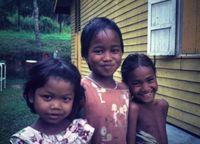
 Gombak was full of happy healthy children from different tribes. They had accompanied a sick parent to hospital along with the healthy parent. It had been found that many Orang Asli were reluctant to leave their kampongs for hospital treatment, and those who did were unhappy in the strange environment. To encourage them to come to Gombak and also to recover quicker it was found that the presence of the family around them was essential. Most of the children enjoyed the newness of the hospital setting and were happy to be occupied during the day with basic lessons in the three Rs, and art and handicrafts in particular.
-
 032 Learning to walk again
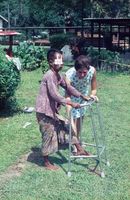
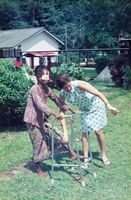
 Busu, a Semai woman had returned from Kuala Lumpur where she had undergone surgery. She was taught to walk again using a zimmer walking frame donated by a UK womens organization.
-
 033 Learning to walk again
 Busu, a Semai woman had returned from Kuala Lumpur where she had undergone surgery. She was taught to walk again using a zimmer walking frame donated by a UK womens organization.
-
 074 Orang Asli Dwelling
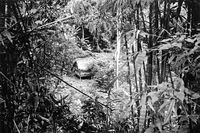
 Another "rumah". Note the abundance of bamboo in the foreground. This is a vital component in house building.
-
 073 Orang Asli Dwelling
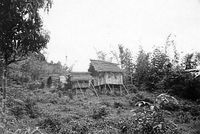
 Orang Asli stilted "rumah" not far from the Satah Medical Post. Wood is used to build the framework and then bamboo strips are used to make the walls. The roof is thatched with palm leaves such as bertam, and everything is secured with ropes made from rotan.
-
 029 Using a nyero
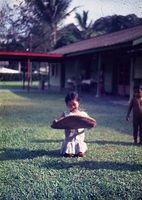
 Timah, a young girl shows how to use a nyero, a flat basket used to dry and sift rice. It is woven from strips of rotan.
-
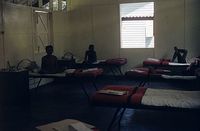 005Tuberculosis Ward
 Mass X-Ray and B.C.G. inoculation programmes have been carried out in the jungle over the years but some Orang Asli need hospitalization

