-
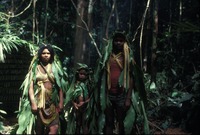 043 People dressed to sing
 Men and women often wear good-smelling plant parts during singing sessions to attract and please the superhuman beings. Here a young woman, her adolescent brother, and a girl wear bandoliers of crushed and twisted ginger stems and wild ginger leaves before a singing session.
-
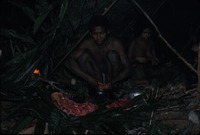 042 Man butchering porcupine
 Besides arboreal animals, Batek pursue several animals that live in holes in trees or in the ground, including bamboo rats (Rhizomys sumatrensis), scaly anteaters (Manis javanica), and porcupines (Hystrix brachyura, Atherurus macrourus). Here a man is cutting up some porcupine meat and putting it in a metal pot while his wife sits inside their shelter. Note the resin torch on the left.
-
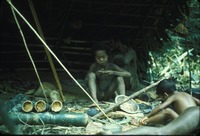 037 Family in lean-to shelter
 This is a typical camp scene a man resting in his shelter, his son working on his blowpipe, and his grandson blowing on the fire. On the lower left lie three bamboo containers full of tuber slices; a blowpipe leans against the roof; and a metal pot with scraps of food in it lies beside the fire.
-
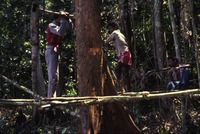 104 Men on scaffold chopping tree
 Batek farmers use various methods to minimize the labor of chopping down large hardwood trees. Here two men have built a scaffold of poles tied together with rattan and are chopping the tree trunk above the buttresses.
-
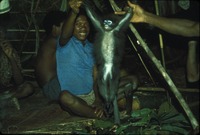 035 Dead leaf monkey
 Dart poison kills by stopping the victims heart. It can kill all kinds of monkeys and apes up to the size of pig-tailed macaques (Macaca nemestrina), which weigh as much as 30 pounds for a mature male. This is a small dusky leaf monkey (Presbytis obscura) that has been killed by blowpiping.
-
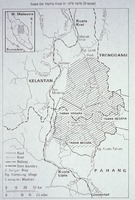 004 Batek De' home area in 1975-1976
 In the middle 1970s, Batek De lived in temporary camps along many of the low-elevation rivers and streams in the area shaded by diagonal lines. Now the area north of the border of the National Park (Taman Negara) has been logged and turned into rubber and oil palm plantations, so most Batek have moved into the still-forested National Park and immediately adjacent areas, with a few living at the government-sponsored settlement at Post Lebir on the middle Lebir River in Kelantan.
-
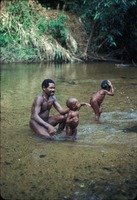 084 Man bathing children
 Men also attend to the daily needs of their children. Here a man bathes his young daughter (whose head is mostly shaven) and an older son. The son was afflicted with spinal tuberculosis. In later years his father had to carry him from camp to camp until he died.
-
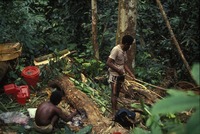 111 Honey-getting camp
 During the day before attacking a bees nest, the work party assembles its equipment near the bee tree. Here one man tends the fire, while another ties together lengths of rattan to form the line that will be used to lower the bees nest. To the left are some plastic containers provided by traders, a piece of bark, and a completed bark basket (inverted on a stump), which will be used as the container to receive the cut-off nest.
-
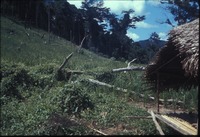 009 Hillside swidden
 Here is dry rice growing in a hillside swidden. Weeds are already starting to encroach on the lower edge of the field. In this instance, wild pigs, monkeys, and birds ate most of the rice before it could be harvested, always a risk when farming in a forested area.
-
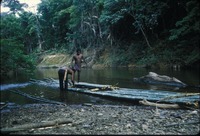 018 Men making raft
 Usually Batek move from one camp to the next on foot, carrying their possessions on their backs, but sometimes they use bamboo rafts. Bamboo grows in clumps here and there along the main rivers. Here two men are making a raft by tying lengths of bamboo to wooden cross-pieces using split rattan bindings. The raised platform is to keep the cargo dry.
-
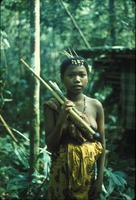 033 Woman with blowpipe
 Although men do most blowpipe hunting, some women, especially young ones without children, hunt for fun. This young woman was an active hunter. She had her own blowpipe, made by a male friend, but no dart quiver, so she stored her darts in her hair. Here she is carrying her blowpipe and two lengths of unprocessed blowpipe bamboo.
-
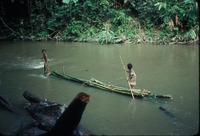 083 Girls rafting rattan
 Children sometimes help with rattan work. Here two girls raft a load of thick rattan downstream to the collection place.
-
 095 Log dump and burning
-
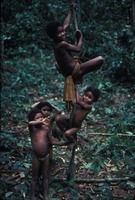 039 Children climbing vine
 Both boys and girls climb trees and vines for fun from an early age. Here a boy (above) and a girl (below) climb a vine, while two girls look on.
-
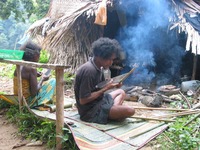 131 Couple making blowpipes for sale
 Batek living near Taman Negara park headquarters now make miniature blowpipes and dart quivers and darts to sell to tourists. Both men and women engage in this business.
-
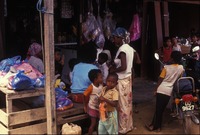 089 Women and children shopping
 About 1980 a road was built connecting Post Lebir and Kampung Macang with the Malay villages and towns down the Lebir River. Batek De and Batek Teh from those settlements began buying supplies at the weekly markets at the nearest village, Kampung Lalok, hiring rides with Malay traders. Here a group of Batek women and children shop at Kampung Lalok. Batek always wear Malay- or western-style clothing when visiting villages or towns.
-
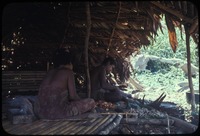 010 Couple slicing nuts
 This couple have boiled and shelled some Pangium edule nuts and are slicing the nut meats into slivers so they can leach the poison out in a stream.
-
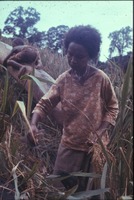 012 Woman harvesting rice
 A woman harvests heads of rice with a Malay-style reaping knife, while one of her children plays on a log.
-
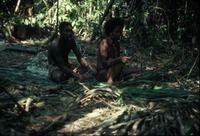 082 Man and woman weaving sleeping mat
 Weaving pandanus leaf sleeping mats and baskets is a specialty of women, but occasionally men also join in. Here a man helps his mother work on a sleeping mat.
-
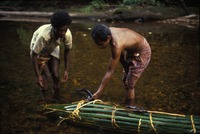 110 Men stowing fish in cage
 Here two men stow some live fish in a bamboo cage.
-
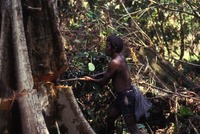 102 Man chopping tree buttress
 Swidden farming requires cutting down large trees, some with flange buttresses at the base. Here a man is chopping through a tree buttress.
-
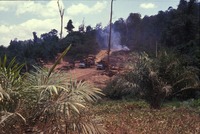
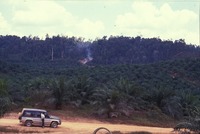 094 Oil palms and burning
 Here a new oil palm plantation (foreground) lies beside some uncut forest (background). The bare earth and smoke on the forest edge suggest that loggers are now removing the remaining forest.
-
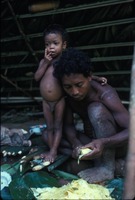 038 Man slicing poisonous tubers
 Both men and women process the poisonous gadong tubers. Here a man slices chunks of gadong while looking after his young son.
-
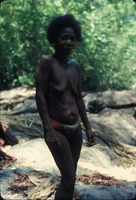 081 Woman in traditional dress
 This middle-aged woman is wearing the basic garment worn by Batek women in the 1970s and earliera long plaited rattan cord (nem) wrapped many times around her waist and supporting a loincloth. In the 1970s the loincloth was cotton cloth obtained through trade, but earlier it would have been barkcloth. She also wears flowers in her pierced ears. When in contact with outsiders, women usually wore cloth sarongs over their nem, knotted above their breasts. Nowadays younger women usually wear panties and bras obtained by trade, and they dispense with the nem.
-
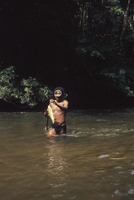 088 Man fishing with speargun
 Since the 1980s, Batek have obtained swimming masks, rubber tubing, and metal rods from traders. They make spear-guns consisting of a carved wooden stock and a strap of rubber tubing that is used to propel a metal spear several feet at high speed and force. The fisherman swims under water to find the fish, usually shooting them from point blank range. This man has just shot a good-sized fish with his spear-gun.

