-
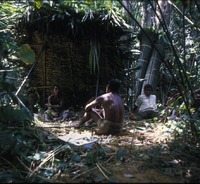 001 Thatch-making camp
 In the early 1970s, Malay farmers sometimes commissioned Batek Teh living at Post Lebir to make thatch for their houses. This trade soon dried up as corrugated metal roofing became readily available. Here some Batek Teh have set up a camp near an abundant supply of thatch palms (Calamus castaneus) and are making rolls of thatch to trade.
-
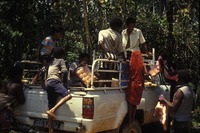 106 Pickup truck in camp
 By 1990, traders came to the upper Aring Batek by road in four-wheel-drive pickup trucks rather than by boat. Here some Batek swarm over a traders pickup, selecting items, including fresh bread rolls, which they receive in return for rattan or Aloes wood.
-
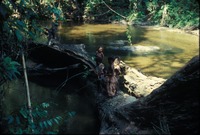 065 Children fishing
 People of both sexes and all ages fish with hook and line, the most frequent method used for catching fish. The metal hooks and monofilament lines are obtained by trade; the rods are made from the midribs of palm fronds; and the bait is worms or insects dug out of the riverbank. Here a boy and girl fish while some other children look on.
-
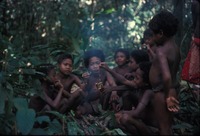 059 Children roasting frogs
 Children also learn to cook at an early age. Here a group of children have built a fire and are roasting some frogs. Because food is normally shared, each child will probably get a tiny bite.
-
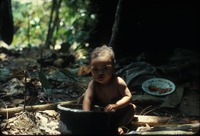 064 Baby eating honey
 The main meal of the day is in the late afternoon or early evening, and usually families eat that meal together. During the rest of the day people eat left-overs and newly obtained food whenever they get hungry. Here a baby is eating honey out of a metal cooking pot.
-
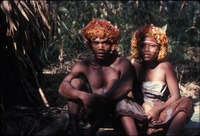 051 Couple decorated with flowers
 This husband and wife wear similar headdresses of flowers and plant stems through their nasal septa. The woman alone has flowers in her pierced ears and white and red lines across her forehead.
-
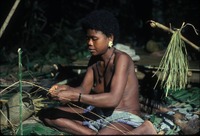 063 Woman plaiting rattan belt
 The characteristic long belt (nem) worn by women is plaited from fine fibers of a certain species of rattan. When one fiber ends, a new one is braided in, so the finished belt can go many times around a womans waist. Here a woman plaits a nem. When it is finished, she will dye it red by boiling it with berries from a rattan bush. A finished nem can be seen around her waist. She is also wearing a cloth sarong, a necklace and bracelet made of black fungus rhizomes, and flowers in her ears. Some thin strips of pandanus leaf dry on the right; she will later make them into baskets like the one on the left.
-
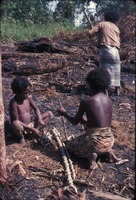 058 People planting manioc
 Sweet manioc (also called cassava; Manihot utilissima) is a plant originally from South America that produces large edible tubers. It grows abundantly even in poor soil and therefore is often included in the swiddens of Malayan Aboriginal farmers. Here a woman digs shallow holes, while two youngsters cut foot-long sections of manioc stems, which they will place at an angle in the holes and partially cover with earth. New plants will sprout from the stem cuttings and produce edible tubers in as little as six months.
-
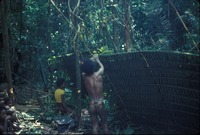 044 Woman making lean-to shelter
 Women are especially skilled at making lean-to shelters. Here a woman fastens thatch shingles, each consisting of three palm fronds, to the upright poles by knotting leaflets around the poles.
-
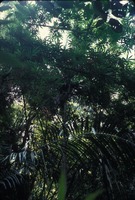 050 Man climbing to get thick rattan
 Thick species of rattan (Calamus manan, Calamus ornatus) are in demand for making walking canes and furniture frames. These species cling so firmly to the treetops, the vines cannot simply be pulled down. Here a young man climbs the tree supporting a thick rattan so he can cut the vine loose from the crown.
-
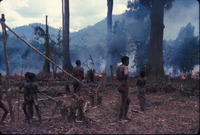 057 Men burning off field
 Swidden farmers first cut down the brush and trees on their field, then let the vegetation dry, and then burn it to clear the soil and convert the wood into ash, which acts as fertilizer. Here some men and children burn dried vegetation for a garden.
-
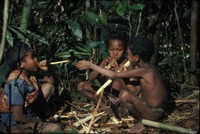 062 Boys eating palm hearts
 A readily-available snack food in the rainforest is palm hearts, the soft pith at the center of the stem where new leaves develop. Palm hearts are similar in texture and taste to young celery shoots. Here some boys are snacking on hearts of the common thatch palm (Calamus castaneus), which grows throughout the lowland forest.
-
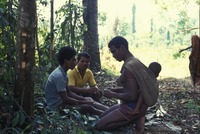 105 Man carrying baby
 Men often care for their young children while in camp. Here a man carries his baby while discussing business with a Batek man and a Malay trader (center).
-
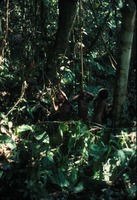 068 Girls shooting blowpipes 1
 Both boys and girls practice blowpipe hunting from an early age. These girls have borrowed blowpipes from relatives (without asking) and are shooting at birds near camp. They were unsuccessful, but they had fun.
-
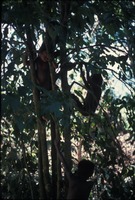 056 Children climbing trees
 Climbing trees in or near camp is a favorite recreation for children of both sexes and all ages. Most people become proficient tree-climbers by the time they reach adolescence. Here three young boys climb some small trees.
-
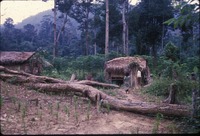 005 Crops growing in swidden
 In this swidden dry rice has sprouted (foreground), and manioc is growing between the Malay-style houses (background).
-
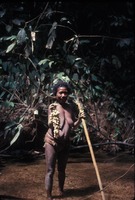 061 Woman with fruit
 People usually go on foraging expeditions looking for tubers, but they take the opportunity to harvest any other food they might find along the way. Here a woman set out with her digging stick, but came back with some turtle egg fruits (species unknown), instead of tubers.
-
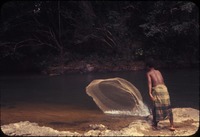 011 Man throwing casting net
 People occasionally buy or trade for circular casting-nets with lead chain weights around the perimeter. Here a man throws a casting-net into some shallow water, hoping to trap some fish under it.
-
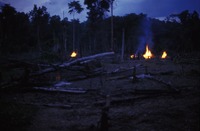 116 Swidden burning
 Here is a swidden field burning at night. Some larger tree trunks will just be left in place, and crops will be planted between them.
-
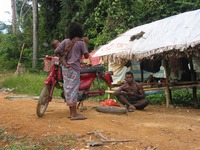 128 Man repairing motorbike
 Batek still visit other groups frequently, but now some people use motorbikes instead of walking or rafting. A few have become skilled mechanics, though without formal training. This man is fixing the back wheel of his motorbike, while his wife looks on.
-
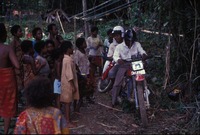 098 Men on motorbikes
 By 1990, logging roads and plantation roads connected the upper Aring settlement and Post Lebir/Kampung Macang, the government-sponsored settlement on the middle Lebir River. Travel by road supplanted most river travel. Here two young men prepare to return from the upper Aring camp to Kampung Macang, where they had houses, on their motorbikes.
-
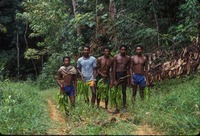 123 Men holding seed pods
 These men are holding the still-green seed pods from a Parkia tree. Batek eat the seeds as vegetables or condiments or trade them to Malays, who regard them highly as flavoring in various dishes.
-
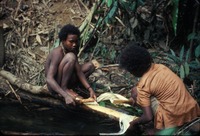 086 Girls washing barkcloth
 By the 1970s, traded cotton cloth and clothing had almost entirely replaced barkcloth garments, but some people still remembered how to make barkcloth by pounding the inner bark of certain tree species into a soft felt. Cloth made from the bark of the dart poison tree (Antiaris toxicaria) was favored because it is pure white. Here two girls, following instructions from their parents, demonstrate how to pound and wash the soft inner bark of the tree to remove the poisonous latex and particles of wood.
-
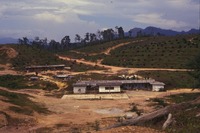 114 Plantation buildings
 Companies developing plantations built workshops and simple housing for workers. Here a project headquarters lies in a valley, with rows of young oil palms on the hills behind.
-
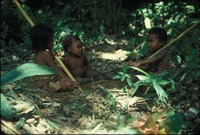 078 Girls play-digging
 Here three little girls play at digging tubers in camp, using their mothers digging sticks.

