-
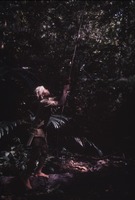 022 Man pulling down thin rattan
 Rattans (Calamus spp.) are closely related to palm trees, but many rattan species have vines instead of trunks. The crown of the rattan clings to the upper branches of forest trees, and the vine trails down to the ground. Some of the small-diameter rattans can simply be pulled down, tearing the crown loose from the supporting branches. The harvester then cuts off the crown and leaf sheathes, cuts the vine into standard trade lengths (nineteen feet for thin rattan), ties the sections into bundles, and then drags them out to a river or other collection place. In the 1970s, Malay traders used rafts to carry large loads of rattan downriver to their villages, where they processed the vines to preserve them and then shipped them out by train or truck. Thin rattan is made into fish traps or is split and used for caning and lashing in furniture. Here a man is pulling down the vine of a thin rattan.
-
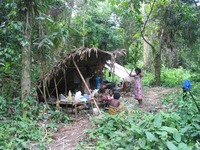 130 Thatched lean-to shelter
 Some families still prefer to live in thatched lean-tos in the forest because they are cooler than the Malay-style houses typically used at base camps.
-
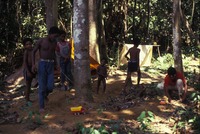 101 Boys playing with toy truck
 Batek parents and children often make toys from forest materials, but recently they have been able to buy some toys from traders or shops. Here boys of various ages play with some toy trucks.
-
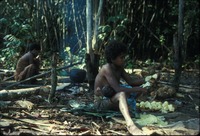 028 Woman slicing poisonous tubers
 One of the most abundant wild tubers is gadong (Dioscorea hispida), which grows mainly on sandy riverbanks. The tubers are larger than potatoes and are shallowly rooted, so they are easy to dig up. Their drawback is that they are poisonous in their natural state. Batek process them to remove the poison. These women have peeled some gadong tubers and cut them into chunks. They are now slicing them into thin slices which they will boil in the iron pot (center). (They can slice the chunks before or after boiling.) Later they will put the slices in an openwork rattan basket, which they will anchor in a stream for a day or so, using the flowing water to leach out the poison. Gadong is easy to gather, but laborious to process.
-
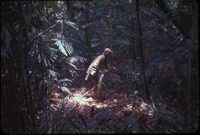 023 Man folding rattan bundle
 Here a man has tied together a bundle of twenty-five lengths of thin rattan. He is folding the bundle in the middle to make it easier to drag it through the undergrowth. Middle Lebir River, Kelantan.
-
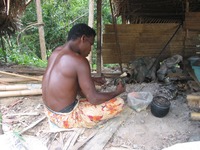 126 Man making blowpipe darts
 Batek living on the upper Lebir River in 2004 still hunt with blowpipes and poisoned darts. Here a man rubs resin on the shafts of some darts to increase their weight and therefore their stability in flight and penetrating power.
-
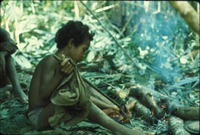 032 Boy making blowpipe
 Most meat in the Batek diet comes from arboreal game (monkeys, gibbons, squirrels, etc.) killed by means of blowpipes and poisoned darts. Blowpipes consist of inner and outer tubes of thin-walled bamboo, each tube composed of two lengths of bamboo spliced end-to-end. To make a blowpipe or replace a section of an existing blowpipe, one dries a length of blowpipe bamboo over a fire, wiping and straightening it in the process, as this boy is doing here.
-
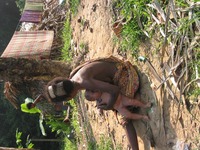 133 Woman wearing bamboo comb
 Batek women in Pahang also continue to wear bamboo combs. This womans baby wears protective amulets around her neck.
-
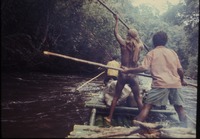 013 Going downstream on raft
 When moving large amounts of supplies or trade goods, Batek use bamboo rafts whenever possible. This one has a platform to keep the cargo dry and a fire on board (foreground). They propel the rafts by means of wooden poles.
-
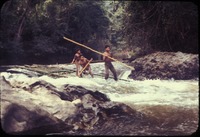 016 Rafting down rapids
 To get through rapids, people sometimes take the cargo off the raft and carry it down to a safe landing place. Then they ride the empty raft through the rough water, as these young men are doing here, and reload the cargo below the rapids. Relai River, Kelantan.
-
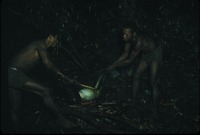 019 Men burning hair off monkey
 Instead of skinning game, Batek burn off the hair and cook the skin with the meat. Here two men are scraping singed hair off a leaf monkey with a stick. Then they will gut it and roast the carcass over the fire. Finally, they will butcher it and distribute portions to all families in camp. Batek share all food if needed, but they make a special point to share meat, which they obtain less regularly than vegetable foods.
-
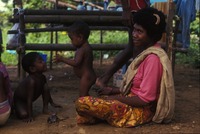 118 Woman, children, and mouse
 Batek sometimes keep small animals as pets, but they do not coddle them as Americans do. When the animals die, people may eat them if they are common prey species (e.g., bats, bamboo rats), but not if they have raised them and become emotionally attached to them. This woman looks on while her two children play with their pet mouse.
-
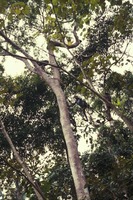 122 Men climbing tree
 If fruit or honey trees are too big around at the base to climb, people sometimes make rope ladders of heavy-gauge rattan stretching between a smaller, climbable tree and the upper branches of the target tree. They throw weighted fishing lines across a fork in the target tree and then pull the rattan across, tying both ends securely to the smaller tree. Here some men have made a rope ladder to the upper part of a tree that produces large pods of edible seeds, like giant beans (Parkia speciosa). Two men can be seen climbing the rope ladder (center right) by grasping the two ropes with their hands and between their toes.
-
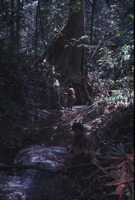 021 Women poisoning fish
 Some species of plants have roots or bark containing latex that can asphyxiate or kill fish. Batek sometimes poison fish in small streams with these substances. Here some women are pounding poisonous tree bark (species unknown) and then wringing the poison out in the water. They will simply pick up the fish that float to the surface.
-
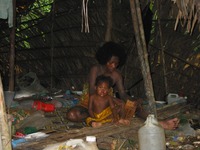 129 Woman carving bamboo comb
 Both women and men carve decorative bamboo combs. Combs increased in size between the 1970s and 2004, but the designs remained similar.
-
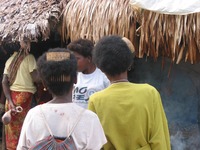 125 Women wearing bamboo combs
 Women wear Malay-style clothes at settlements and basecamps, but still wear distinctive bamboo combs in their hair.
-
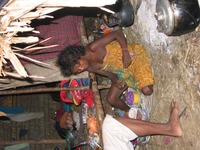 132 Woman making blowpipe dart for sale
 Men, women, and children living near Taman Negara park headquarters make blowpipe darts to sell, together with quivers and miniature blowpipes, to tourists.
-
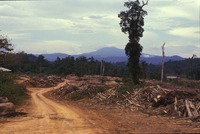 121 Log dump
 Some crude sawmills were set up near the source of the trees to saw logs into rough planks. This is the log dump at one such sawmill with a pile of scrap wood in the foreground.
-
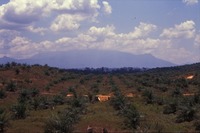 097 Young oil palms
 Oil palms are planted in rows to facilitate care and harvesting. Workers suppress seeds and insect pests with massive applications of chemical herbicides and insecticides, some of which wash into streams and poison the water.
-
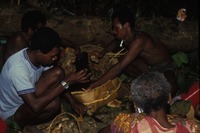 113 Men sorting honey
 Here some men are sorting out the honey, honeycomb, larvae, and bees wax from a newly-obtained bees nest. They use flashlights acquired from traders to illuminate their work.
-
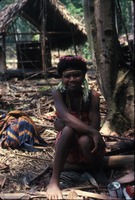 025 Decorated Woman
 Women and men often decorate themselves just for fun with flowers, leaves, and pigments. This woman has put shredded fragrant leaves (probably from wild gingers [Zingiber spp.]) in her ear holes, a garland of flowers on her head, and has painted a line of white lime paste (obtained by trade) across her forehead.
-
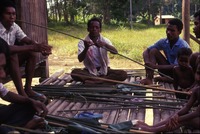 091 Men making blowpipes
 Batek living at Kampung Macang in 1990 still used blowpipes for hunting. Here some men are making new blowpipes from blowpipe bamboo that they collected on their motorbikes.
-
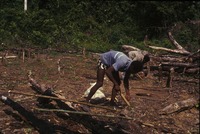 117 Men planting rice
 Two men are dropping a few rice seeds in each hole and tamping soil over them with the butts of their bamboo seed containers. A square altar can be seen on the ground between them. Before starting to plant, they burned some incense on the smoldering log inside the altar and recited a spell to the earth spirit, a Malay practice that they adopted along with swidden farming.
-
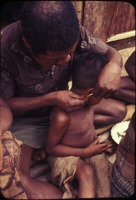 015 Man piercing girls ears
 Women, but not men, have their ears pierced so they can wear decorative flowers, leaves, and so forth in them. The girls themselves decide when to have the piercing done. Here a man pierces a girls ear using a porcupine quill. He previously cooled her ears with water over which he had said a spell (in the bowl on the left).
-
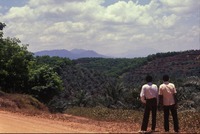 096 Boys overlooking plantation
 Mature oil palms have now replaced the forest in the Relai River Valley. Here two young men in western dress look over an oil palm plantation where their parents once lived by hunting and gathering in deep rainforest.

