-
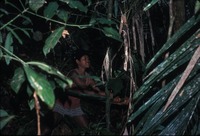 049 Man pulling down thick rattan
 A young man pulls down the vine of a thick rattan after he cut the vine loose from its crown. He will then slice all the leaves off the vine, cut it into nine-foot sections, and tie the sections into bundles of four or five pieces, which he will carry to the collection place on his shoulder.
-
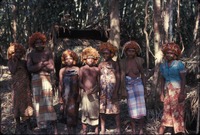 055 Group decorated with flowers
 When flowers are abundant in the forest, Batek often make them into elaborate body decorations. Here a man and six women and girls wear headdresses of flowers on bark and rattan frames and plant stems through their nasal septa. The women also wear lines of white lime paste across their foreheads and flowers in their pierced ears.
-
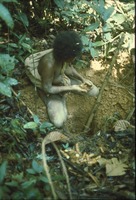 067 Woman digging tubers 2
 Here she is separating pieces of tuber from a shovel-full of dirt.
-
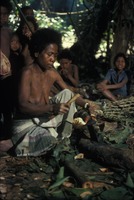 060 Woman making digging stick blade
 Batek are clever at reusing such scarce and valuable materials as iron. Here a woman is making a chisel-shaped digging stick blade from a broken piece of a bushknife blade. She has inserted the blade in a wooden handle, heated it in a fire, and is now pounding the end to thin it, using a ball-peen hammer and an ax butt for an anvil. She will later sharpen the newly-formed cutting edge with a file.
-
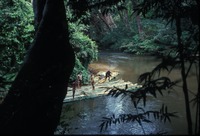 048 Rattan on rafts
 In the 1970s, Malay rattan traders came up the Lebir River and its tributaries in outboard motorboats. They brought foodssuch as rice, flour, and sugarand other goodsincluding metal tools and clothto trade for rattan. They made agreements with individual Batek to collect certain amounts of rattan by a date when they would return. Here some Malay traders are assembling a consignment of rattan on bamboo rafts, which they paid some Batek to build. The traders will then pole the raft-loads of rattan downstream to their villages.
-
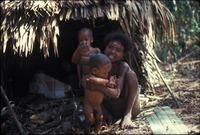 054 Woman bathing baby in camp
 Batek of all ages bathe at least once a day, usually in a river or stream. Here a woman bathes her baby in front of her shelter by pouring water from a tin over his head.
-
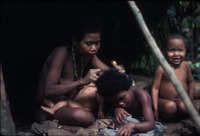 047 Mother delousing daughter
 A mother, with her baby on her lap, searches through her daughters hair and pinches the lice on a bamboo spatula.
-
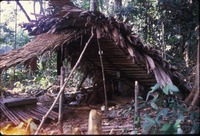 006 Elaborated lean-to shelter
 Most lean-to shelters consist of a single sloping panel of thatch, which is supported by a horizontal pole on the open front side and falls to the ground in the back. During especially wet weather, triangular side-panels may be added, and low platforms of logs and split bamboo or bark are made to raise the sleeping mats above the ground. This lean-to shelter has two sleeping platforms, one in back and the other in front under a small roof extension.
-
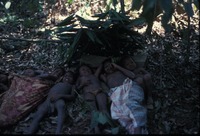 053 Children pretending to sleep
 Playing house is also popular. These young children have made a crude leaf shelter and are lying on a pandanus mat pretending to sleep.
-
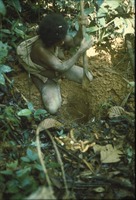 066 Woman digging tubers 1
 People seeking wild yams scan the treetops looking for the characteristic heart-shaped leaves. Then they trace the vine to the ground and dig down the stem until they reach the tubers. Takop (Dioscorea orbiculata), the most commonly found species, may have several tubers on each stem. Diggers follow each tuber as it winds its way underground, bringing up pieces of tuber with each thrust of the digging stick. Some tubers are several feet long. Here a woman digs while carrying her baby in a cloth sling on her back. She uses a digging stick with a small shovel blade, which is obtained in trade. A pile of tuber pieces lies beside the hole (foreground).
-
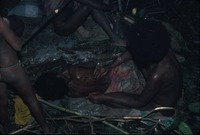 046 Woman medicating boy
 Batek use numerous plant-based medications. Here a woman spreads water containing medicinal leaves on the back of a boy with a fever.
-
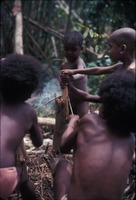 052 Children making fire
 Children learn very young to make fire with smoldering logs, matches, lighters, flint and steel, and rattan and dry wood. Here some young children are starting a fire by sawing a strip of rattan back and forth on a dry stump.
-
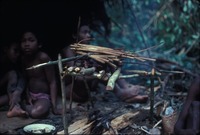 045 Meat drying over fire
 Occasionally people bring in more meat than camp members can eat in a single day. Here some porcupine meat is being dried to preserve it for few days. Pieces of pith for blowpipe darts dry on top of the meat.
-
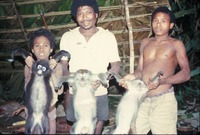 041 Three dead monkeys
 Here a boy (left) holds a dead dusky leaf monkey (Presbytis obscura), and two men hold banded leaf monkeys (Presbytis melalophos).
-
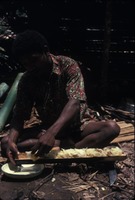 027 Man removing cooked tubers from bamboo
 People usually cook gadong again, after the poison has been leached out, by steaming it over a fire in a section of bamboo, sometimes with fish or vegetables mixed in. Here a man has split open the bamboo container and is removing the cooked gadong.
-
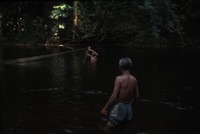 103 Men putting out net
 Batek also fish with gill nets, which they obtain from traders. They usually stake the nets out in a stream in the afternoon and retrieve them, with any entrapped fish, the next morning. Fish try to swim through the openings in the net, and their heads get stuck; when they try to back out, the net snags their gills. Here two men are putting out a gill net.
-
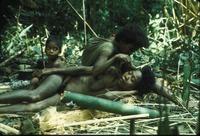 036 Woman delousing her mother
 Hair lice are a constant nuisance for Batek. Men sometimes shave their heads to get relief, but women usually depend on friends and relatives to pluck out the lice and crush them. Here a woman is delousing her mother using a thin bamboo spatula made especially for this purpose, a common scene during leisure hours in Batek camps.
-
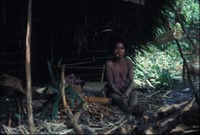 029 Woman sitting in family shelter
 This woman is sitting in her family lean-to shelter surrounded by some of the typical accoutrements of Batek life. Beside her are a bamboo blowpipe dart quiver, some pandanus baskets, some wadded up cloth sarongs, a pile of uncooked takop tubers (Dioscorea orbiculata), and a charred section of bamboo which has been used for cooking. Behind her, stuck in the thatch, are some sections of blowpipe bamboo, and in front, hanging from a pole, is a bundle of pith that will be used to make the butt-cones of blowpipe darts.
-
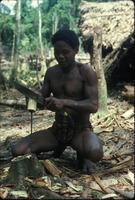 024 Man carving bushknife handle
 Batek are skilled wood carvers. Here a man is carving a new handle for a bushknife.
-
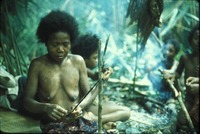 034 Woman plaiting necklace
 Women are skilled at plaiting strands of natural materials into necklaces and armbands. Here a woman plaits a necklace from black rhizomes of a fungus that grows on rocks. Such rhizomes are thought to ward off disease. Batek wear the necklaces themselves or trade them to Malays.
-
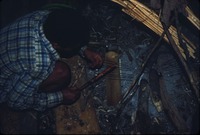 030 Man poisoning darts
 This man is applying coats of poison to newly made blowpipe darts. The latex of the poison tree (Antiaris toxicaria) has been dried on a bamboo spatula, which is stored in a thin bamboo tube. Here he is heating the spatula to soften the poison and then rolling the tips of the darts in the sticky poison. A bundle of pith from a type of rattan vine, which will be made into dart butt-cones, dries over the fire.
-
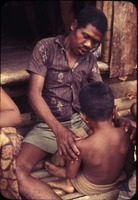 017 Man finished piercing girls ears
 After piercing the girls ears, the man puts tiny pieces of medicinal plant stems on the quills to prevent infection. The quills and stems are left in place until the holes heal. Here he examines his handiwork.
-
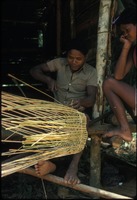 026 Man making rattan basket
 While women specialize in making baskets and mats of pandanus leaves (Pandanus spp.), men usually make the rattan (Calamus spp.) baskets. This man is making an openwork rattan basket for leaching poison out of a species of poisonous yam (Dioscorea hispida).
-
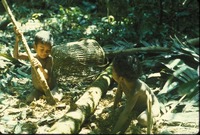 040 Boy and girl play-digging
 Much of childrens play is imitation of the serious activities of adults. Children of both sexes learn how to dig tubers by accompanying their mothers on tuber-digging expeditions. Here a little boy (left) digs with a full-sized digging stick, while a girl (right) scoops pretend tubers out of a hole. A rattan basket used to leach gadong slices lies behind them.
-
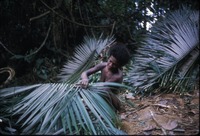 002 Woman making thatch
 This woman is making thatch from fronds of the common thatch palm (Calamus castaneus). She first flips all the leaflets on each frond to the same side of the stem, so water will all drip in the same direction. For thatching lean-to shelters, she will then make shingles of three fronds, two facing in one direction and one in the other.

